Is Axiom Trade an Exchange? Terminal vs DEX vs Aggregator, Explained
Table of Contents
Axiom Trade is not an exchange. It is a trading terminal: an interface that sits above the exchanges rather than being one. When you swap a token on Axiom, Axiom does not match your order against another customer and does not take custody of your funds. The swap executes on a Solana automated market maker such as PumpSwap or Raydium, and Axiom is the software you used to find the token, size the trade, and send it there. Your keys stay with you throughout, held through Turnkey's infrastructure with an exportable 12-word seed phrase. This matters for two concrete reasons. First, custody: there is no company-held balance for anyone to freeze, and Axiom's documented sign-up flow has no identity-verification step. Second, cost: because your trade touches a venue Axiom does not operate, you pay that venue's fee on top of Axiom's own, which is why the advertised 1% is never the whole bill.
The category confusion behind the query "axiom exchange" is understandable, since the terminal does the thing you go to an exchange to do. But the distinction is not pedantry, and the rest of this page is why.
Terminal, DEX and aggregator are three different layers, and Axiom is the top one. The layer a product occupies tells you who holds the balance and how many separate fees your trade pays. Those are the questions the category label is actually answering.
 What a centralized exchange does that Axiom does not
A centralized exchange such as  Coinbase,
  Binance or
  Kraken does four things Axiom does not:
It takes custody. You deposit funds and the exchange holds them. Your balance is a number in the company's database and a claim against the company, not coins you control.
It runs an internal order book. Your buy is matched against another customer's sell, inside the exchange, off-chain. Nothing touches a blockchain until you withdraw.
It asks for identity documents. Signing up at a major centralized exchange involves an identity-verification step before you can trade or withdraw. Why that step exists is a regulatory question, and not one this page tries to settle.
It can freeze you. Because the exchange holds the balance, it can stop you moving it.
Axiom does none of these. There is no deposit in the exchange sense, no internal matching on spot, no identity-verification step in the documented signup, and no company-held balance to freeze. The consequence people miss: the withdrawal step that defines exchange use has no equivalent on Axiom, because your funds were never anywhere else.
What a DEX is, and where Axiom sits relative to one
A decentralized exchange is the on-chain venue where a swap actually happens. On Solana that usually means an automated market maker: a smart contract holding a pool of two tokens that prices trades by the ratio between them.  Raydium is one. PumpSwap, where
  Pump.fun tokens trade, is another.
A DEX takes no custody either, which is why "non-custodial" alone does not distinguish Axiom from a DEX. The difference is that a DEX is a venue and Axiom is a client. The pool holds liquidity and executes the swap. Axiom finds you the token, shows you the chart, sets your slippage and MEV mode, and submits the transaction.
Analogy, with its limits stated: a DEX is the market, and a terminal is the trading screen you use to reach it. The analogy breaks in one important way, which is that a stock trading screen usually does hold your account, whereas Axiom does not.
This is also why "is Axiom a DEX" has a cleaner answer than it looks. The pools Axiom routes into are on-chain contracts that any Solana client can reach, and Axiom is one of the clients reaching them. That dependency runs in one direction only, and the direction is what defines the layer Axiom occupies.
What an aggregator does, and what Axiom routes through
An aggregator's defining job is price: it splits a single order across several venues to get a better fill than any one venue offers.  Jupiter is the canonical Solana example.
Axiom routes into venues, but price improvement is not what its feature set is organized around. What it documents is discovery and speed: the Pulse feed surfacing launches behind a filter set, one-click Quick Buy, hotkey execution, and an in-house sniper for Pump.fun to Raydium migrations running on custom nodes. Those features act on tokens that are minutes old. Splitting an order across venues to shave basis points off a liquid pair is not something Axiom's documentation describes.
So: Axiom uses routing, and calling it "an aggregator" describes a mechanism rather than the product.
Perpetuals are the one place the layering is different and worth stating precisely. Axiom's documentation describes its perps as routed to  Hyperliquid, which genuinely is an order-book exchange. There, Axiom is a front end onto someone else's order book, and Hyperliquid's liquidity, matching and fee schedule are Hyperliquid's own, published in Hyperliquid's documentation rather than Axiom's. Axiom's fee docs list a 0.01% charge per perpetuals transaction on Axiom's side of it. Even here Axiom is the interface, not the venue.
Why the distinction matters to your keys
This is the part with practical consequences.
There is no company-held balance to freeze. Axiom can stop serving you its interface. It cannot stop you spending funds in a wallet whose seed phrase you hold. With that phrase exported, the wallet works through any Solana client whatever happens to Axiom.
Platform failure is survivable, and this has been tested. In late August 2025, a Pump.fun API change broke selling across terminals built on that API, Axiom included, for hours. Axiom's own Discord notice at the time said Pump.fun "has pushed a breaking change without notifying trading bots" and told users that if they needed to sell they could do so on Pump.fun's website. Traders who had exported their seed phrase moved to another client and sold. Traders who had not sat and watched. On an exchange, an outage means you cannot reach your funds. On a terminal, it means you cannot reach your funds through that terminal, which is a much smaller problem if you prepared for it.
The risk that remains is informational rather than custodial. Axiom's February 2026 incident, in which an employee used an internal dashboard to view user wallets, is the failure mode this architecture still permits. On Axiom's own account of it the dashboard showed wallet information rather than moving funds, and no loss of funds or private keys has been publicly reported. What an internal tool can reach is not something anyone outside the company can verify, which is the honest limit of that reassurance. Our security guide covers what the architecture does and does not bound.
Trade on Axiom
Sign up through our link for an automatic 10% discount on the platform fee, applied from your first trade.
Trade on AxiomWhy the distinction matters to your costs
Because your trade crosses layers, it pays each layer. This is the single most useful consequence of understanding the category, and it explains why the advertised fee never matches the bill.
| Layer | Who charges it | On a $500 swap |
|---|---|---|
| Terminal (Axiom) | Axiom's platform fee | 1% gross, to 0.75% net via cashback: $5.00 to $3.75 |
| Venue (the AMM) | PumpSwap, Raydium and similar | Set by the venue: on PumpSwap, 1.25% to 0.30% by market cap, up to $6.25 |
| Network (Solana) | Validators | A fraction of a cent, paid even on a failed trade |
| Optional | Priority fee or Jito tip | Default 0.001 SOL each, raised in a race |
| The pool | Realized slippage | Unbounded, set by depth against your size |
Axiom's own rates from its fee documentation, read August 2026. The AMM row is PumpSwap's fee, which Pump.fun sets and publishes on its own fee page, read August 2026, tiered by market cap. It is their schedule to change, so check it there.
On an exchange, one fee covers everything, because one company operates every layer. On a terminal, four parties get paid and only one of them is the company whose fee you compared. That is why choosing a terminal on headline rate alone misleads, and why the Solana terminal fee index breaks a single swap into all four components. The fee guide covers Axiom's own layer in full.
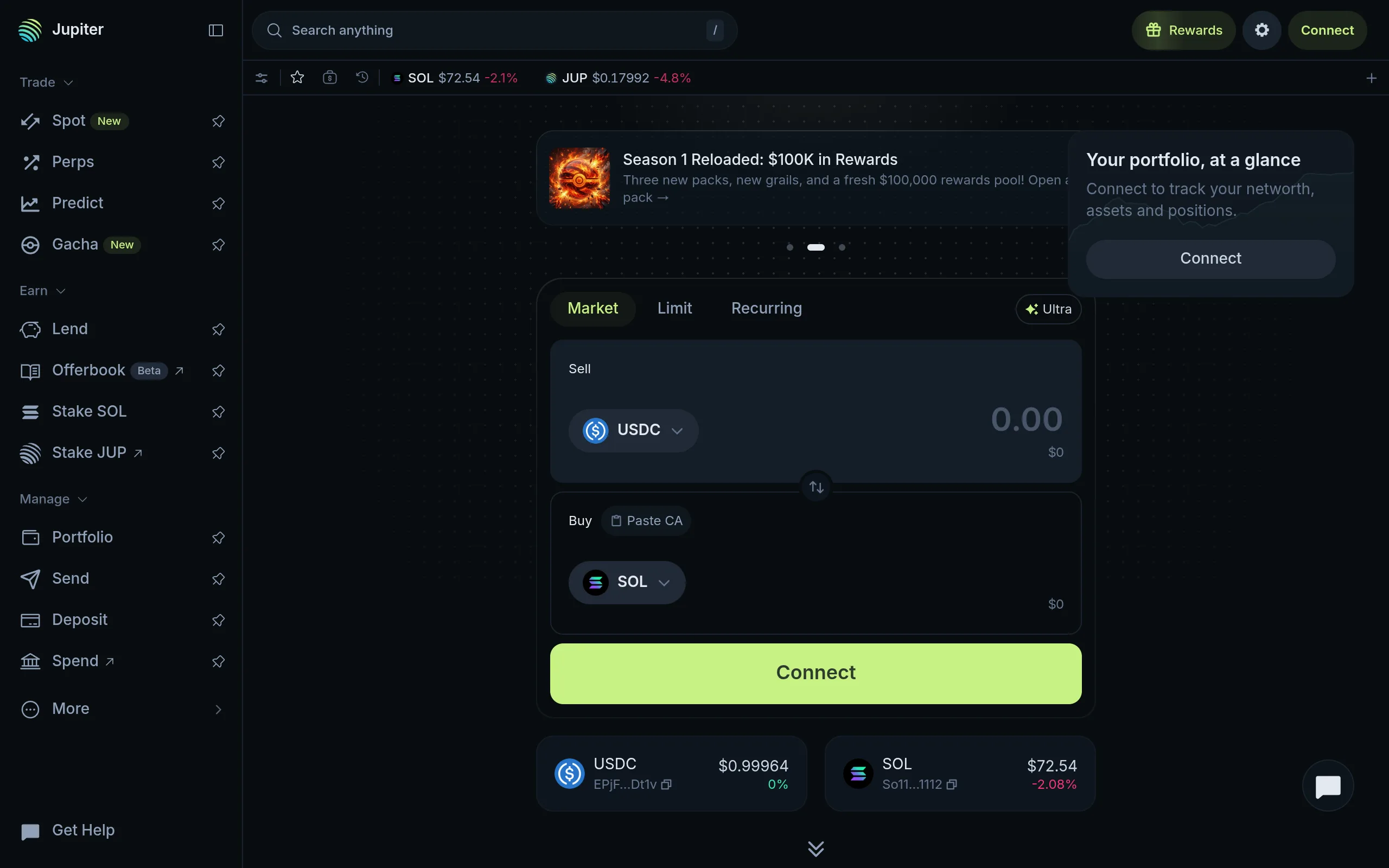
Source: Jupiter, used under fair use for educational purposes
The short version
Axiom Trade is a terminal. Not a centralized exchange, because it holds neither your funds nor your identity documents. Not a DEX, because it is a client rather than a venue. Not really an aggregator, because best-price routing is a mechanism it uses rather than the thing it sells.
What you get from that: your keys, a signup with no identity-verification step, no company-held balance for anyone to freeze, and survivability when the platform breaks. What you pay for it: several fees instead of one, and the discipline of understanding which layer each came from.
If you want to see the layers in motion on a real trade, the terminal walkthrough follows one swap from the order ticket to the fill. If you are comparing terminals, the comparison hub covers the alternatives, all of which sit at the same layer.
Get the Referral Discount
A 10% reduction on Axiom's platform fee, stacking on top of whatever cashback tier you reach.
Sign Up on AxiomFrequently Asked Questions
Axiom describes itself as a trading terminal, which is an interface layer rather than a trading venue. Its documentation describes a non-custodial product with no order book of its own for spot and no internal matching of one customer against another. A spot swap placed on Axiom executes on a Solana automated market maker such as PumpSwap or Raydium, and Axiom is the software you used to send it there.
Neither label fits cleanly. A centralized exchange takes custody of customer funds and matches trades internally. A decentralized exchange is the on-chain venue where the swap settles. Axiom sits above both as a client that routes an order into existing venue liquidity while the keys stay in a wallet you control.
You do, on Axiom's own account of it. Axiom's documentation at docs.axiom.trade says it provisions a wallet using Turnkey's key-management infrastructure and issues you a 12-word seed phrase at signup that can be exported at any time into Phantom, Rabby or Solflare. Turnkey documents its own architecture separately. The practical difference from an exchange is that there is no company-held account balance, only a wallet you can take elsewhere.
Axiom can stop serving you its interface. It does not document any ability to freeze a user wallet, and the wallet it provisions comes with an exportable seed phrase. Once that phrase is exported, the funds stay reachable through any Solana wallet regardless of what Axiom does. A centralized exchange can freeze a balance because it holds the balance.
Axiom's documented sign-up flow does not include an identity-verification step. The one identity-adjacent path is the optional Coinbase fiat on-ramp, which is Coinbase's product and carries whatever limits Coinbase publishes for it. Whether any identity-verification requirement applies to a particular user in a particular jurisdiction is a legal question this site cannot answer for you.
Not in the usual sense. An aggregator's defining function is splitting one order across several venues to improve the price, the way Jupiter does on Solana. Axiom routes orders into venues, and its documented feature set is built around discovery and execution on a single surface rather than around order splitting.
Four separate places. Axiom charges its own platform fee, documented at 1% gross and falling to 0.75% net through its SOL cashback tiers. The automated market maker your trade executes on charges a fee that venue sets and publishes, not one Axiom sets. Solana charges network gas, and a priority fee or Jito tip is optional on top. Realized slippage is the fourth cost and belongs to the pool.
Axiompedia is an independent educational resource. It is not affiliated with, produced by, reviewed by, endorsed by, or sponsored by Axiom Innovations Inc., the operator of axiom.trade, or any of its affiliates. "Axiom" and the Axiom logo are trademarks of Axiom Innovations Inc., used here only to identify the product this site writes about. Full disclaimer.
Disclaimer: Nothing on this site is legal, tax, financial or investment advice. Trading carries risk, including total loss. Whether any activity described here is permitted where you live, and how it is taxed, depends on your jurisdiction and your circumstances. Consult a qualified professional and the primary sources before acting. Past performance does not indicate future results. Always check the primary source and do your own research before trading. This site contains referral links, which are disclosed on the disclosure page.
Ready to Start Trading?
Sign up on Axiom through our link for a 10% discount on trading fees, applied automatically with referral code axiompe.
Save 10% on Fees